Summary:
Nick Hennegan looks at Soho, Pubs on Dean Street, Karl Marx and Dylan Thomas with his lost script and A Visit To America.
Send in a voice message: https://anchor.fm/bohemianbritain/message
Nick Hennegan's Bohemian Britain
Lifestyle tales from the city

Nick Hennegan looks at Soho, Pubs on Dean Street, Karl Marx and Dylan Thomas with his lost script and A Visit To America.
Send in a voice message: https://anchor.fm/bohemianbritain/message

Nick Hennegan talks to young London-based New Yorker, singer songwriter Esme White, about her first single Pearly Gate Crashers and her early family influences and career to date.
I’ve been invited to a party. By Fitzrovia in London! — Send in a voice message: https://anchor.fm/bohemianbritain/message

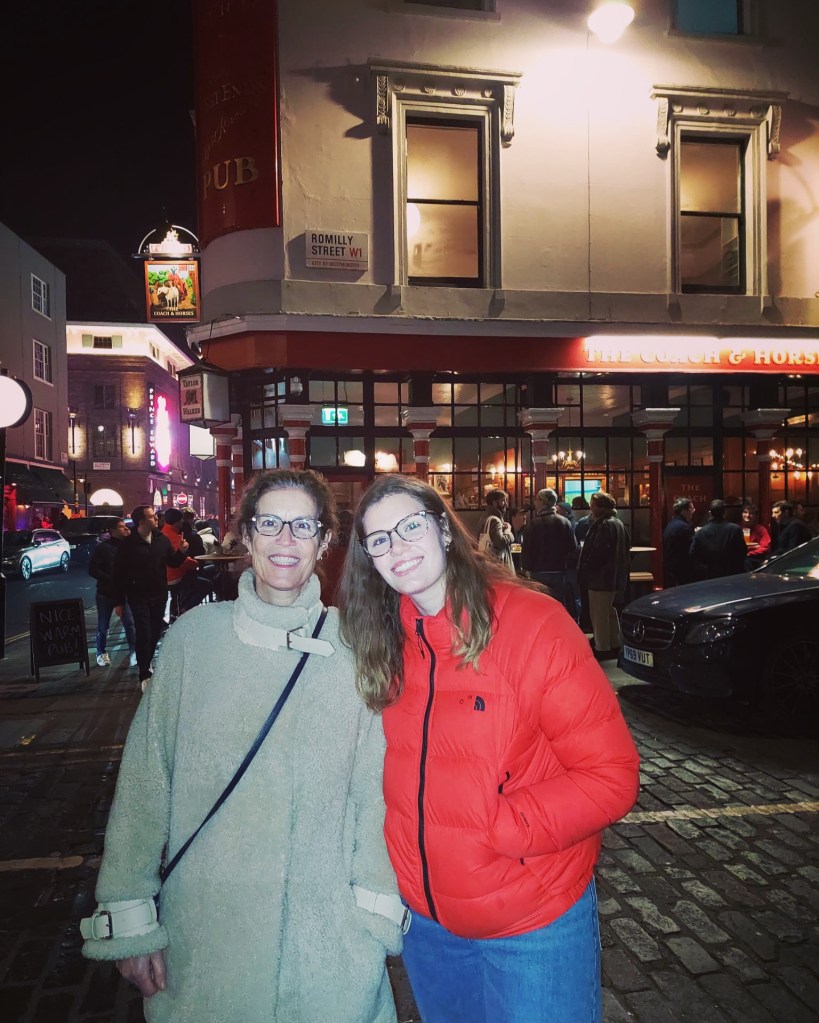
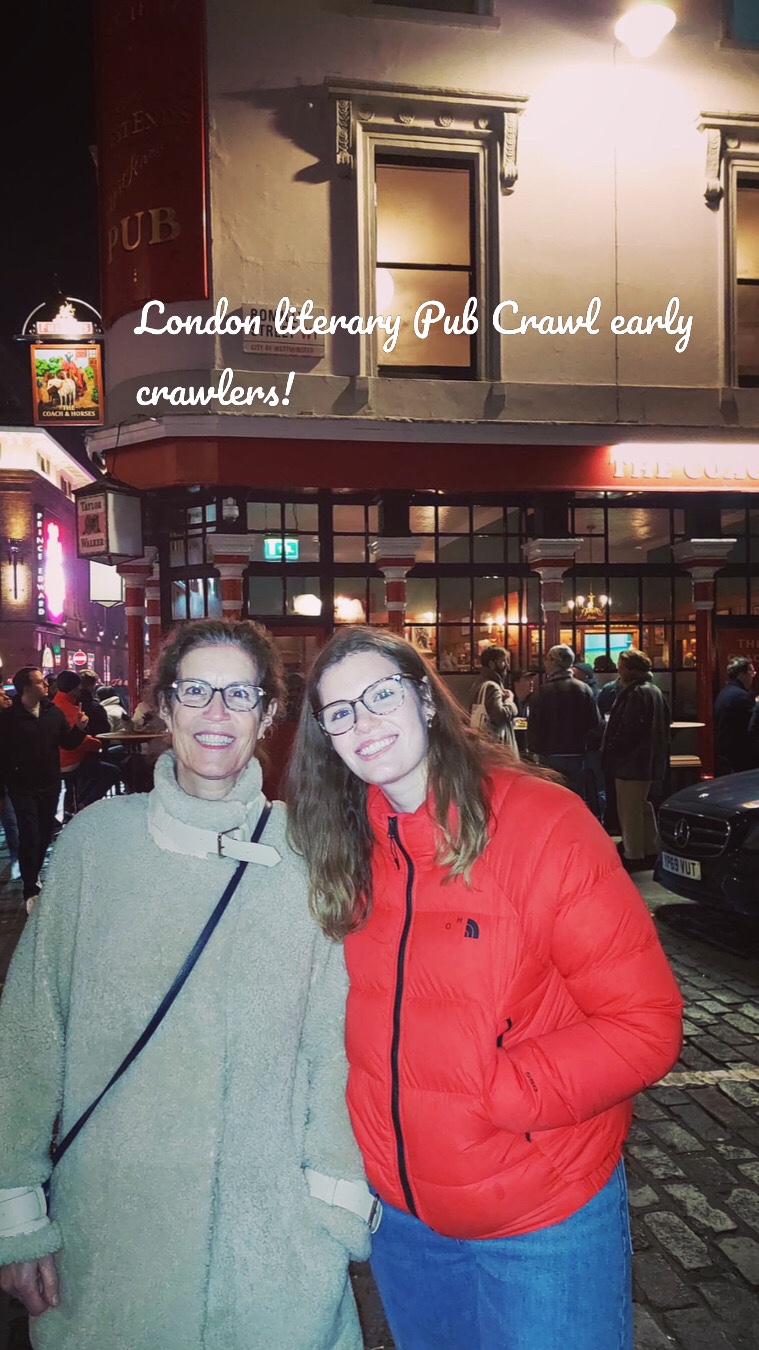
Internationally acclaimed Poet Skye Bowdon and her father visiting London to collect her latest award, The #Foyle Prize for Creative Writing. They’re obviously aware that the visit would not be complete without experiencing the London Literary Pub Crawl!
Join us every Saturday in Soho!

This is from the archive and features a 3 minute video behind-the-scenes of the production at Brighton Pavilion theatre. This was before I bought a Mac! How times have a-changed..!
Hoorah! Me first video! This is very rough and is my first attempt with a little mini DV camera I got back in August for my birthday. Spot the not so deliberate mistake in the opening caption. November 2008? I think that should read 2007.
I’ve also found an editing programme on this computer called ULead, and as it’s free, I’ve tried to edit with that. If you know any other or better free editing software, please let me know.
I’ve always been taken with the drama and power of the visual image and, indeed, wrote a storyboard for a film version of Henry V – Lion of England back in 1993. In 1997 (flippin’ eck, TEN years ago!) I made a short film for ITV’s First Cuts called ‘Boy, Girl, Boy, Bike?’ I may try and get it up on here, although it was made in the days before Digital media and I think I only have a VHS copy, so I’m not sure how the technology works. It’s about 12 minutes long and is a sweet rites of passage tale with the lovely kids who were involved in my production, ‘A Ghost of A Chance’.
This little film looks backstage at Brighton and is, I hope, a bit of a teaser for our Spring Tour, which is going ahead despite funding problems. Myself and Deborah, our part-time administrator, are going to pitch a bank for working capital, given the excellent tour Penny, the booker, has arranged for the Spring. It’s a bit more urgent for me than anyone else, as my house is on the line! But somehow I’ve managed to survive this long and my plans for the next 3 years will mean Maverick will be in a very strong position, if I can just get through the next three months…!
Busy week; we’ve stared a new DipCP course for new producers; rights secured for ‘Two’ and ‘Educating Rita’; UK tour for ‘Winston & David’ Sept ’23 – and extra days filming on ‘The Crown’ for Lucy! #theatrelife #NetflixUK
A quick update about new theatre tours; TWO and Educating Rita! — Send in a voice message: https://anchor.fm/bohemianbritain/message
I thought I’d share this from November 2009 when British and Allied troops were in Afghanistan. Dad lived another 7 years after this. But it remains the only time he ever visited London. And one of very few times he talked about his war-time experience.

It’s been an unusually domestic week for me. And with remembrance day, British troops in Afghanistan and the Sun newspaper giving Gordon Brown a bad time over his handwriting, one that has given me pause for thought too.
It was a big week on the domestic front because my Dad, at 86, had never been to London before. He apparently drove near it in the 1940’s, but that was in the back of an army truck. So he and my lovely sister came down for a few days. I don’t think I ever spend enough time with my family. Is it just me or do we all feel like that? I am so focused on trying to create art and avoid arts oft nearby regular bedfellow – grinding poverty! So it was nice when they came down, and as ever Bex was the perfect hostess, fussing over every detail.
Dad actually passed near London in the 1940’s to jump on a plane for Operation Market Garden at Arnhem. Dad was a paratrooper, a ‘Red Devil’ and was part of the cock up that marked a bridge too far. He was wounded and spent a long time as a P.O.W. However, it’s just as well he was captured when he was. I checked his company details on the ‘tinterweb and the very day of the morning of his capture most of his comrades were wiped out by a machine gun nest. Incredible, but true.
So in London, we did the usual thing, showing Dad and Sis around darkest Chiswick and taking them to our favourite haunts. I’d met them both at Euston Mainline station and we took the Northern and District Underground Lines to get home. Now Dad is sharp and full of humour and although his hearing isn’t too good (and he stubbornly refuses to wear his hearing aid) and he’s not as lithe as he used to be, he’s nobodies fool. So it was strange to see how strange the everyday of London was to him. He was fascinated by the electronic signs inside the tube carriages. He thought they were a great idea and seemed transfixed by them all the way back to Stamford Brook. He couldn’t understand the need for all the different tube lines until I explained the distances involved and that the map was a condensed representation of the network.
“And what if you’re colour blind with all those colours on that tube map?” he commented. He was also shocked by how violently the turnstile doors slapped open and shut. I think he may have a point there.
But what really made me think was us walking from Westminster to Embankment pier past the RAF war memorial. I was slightly ahead of Dad looking for my camera. When I looked back he was looking up at the memorial and had his cap in his hand.
“You all right Dad?” I asked.
“Just thought I’d say hello to the boys,” he said and nodded at the memorial. “They looked after us as much as they could.” I’d never heard Dad talk like that.
I took the pic, then he doffed his cap to the memorial, put it on his head and off we went.
I asked him about it later. Dad was born into extreme poverty, the youngest of eleven kids. His mom, my Grandmother, died when Dad was seven. My Grandfather, Paddy, was an Irish labourer from Co Mayo in the west of Ireland. He was a big drinker (so THAT’S where I get it from… not my fault then!) who would often use his belt on the kids when he’d had a bit too much, which was apparently most nights. I have some sympathy. Not with beating the kids, of course, but the pressures on him must have been immense. There were 12 of them, pre welfare-state in the 1930’s depression, in two rooms in an up and down house in Leeds and often they went hungry too. When Paddy sobered up later in life he would often tell Dad the army was a good way out. Three square meals a day was a lot better than the everyday life they enjoyed. So aged 16 Dad and a mate from Leeds lied about their ages and signed up. Not the best of times to join the army. As Paddy said,
“Join the army, yes, but not when there’s a bloody war on!”
So Dad was grateful to the airman who took care to give them a safe landing at Arnhem. But it transpired later that there were other people looking out for him too. Dad’s C.O. never acknowledged Dad’s age. But the day they got captured, the day Dad’s platoon was massacred, the C.O. got his company up in the early morning, and moved off quietly, leaving my wounded Dad and his young chum asleep. When they woke up, the older guys had gone. The German officer who first captured them looked set to turn violent until he saw their age. In perfect English he said to Dad, “You are too young to die in this war.”
I attended a wedding in Scotland a few years ago. Behind the bar was a young man… maybe 19 years old. He was wearing a Parachute Regiment Tie. I asked him about it and he said he was in the Territorial Army. I happened to mention that my Dad was in 2 Para and dropped at Nijmegen Bridge in 1944. His reaction took me completely by surprise. He shook my hand. “Woah! Your Dad! What heroes those guys were.” And in spite of protestations, I was unable to pay for a drink all night!
Dad’s reaction to the memorial and the young guy in Scotland got me to thinking about the current engagements. The loss of life is hugely regrettable in Afganastan at the moment and indeed many of my cousins in Leeds were in the forces,. But was WW2 the last TRULY justifiable war? Can the 9/11 tragedy be compared to the invasion of Poland by Hitler? Is it right the Sun newspaper seems to be making an attempt to discredit the P.M. by using and directing the anger of a grieving mother? Isn’t that just a bit too much 21st century?
Something don’t smell right, kids. I feel uncomfortable. I suppose it’s always us, the great unwashed, the working class who get stuffed by other peoples principles; it’s always us that ends up galloping into the cannons or marching into the hail of shot. But is it right, nowadays? I dunno. This time last year, during a performance of Henry V – Lion of England, in Brighton I had actor Ed Morris place a poppy in his coat at the end of the show which caused a palpable gasp from the audience. (I won’t give too much away about that. I want you to see the show!) But what do you think?
I’m just very grateful to Dad’s C.O. and that unnamed German officer in Holland. Or I almost certainly wouldn’t be here to ask these questions.
Photo by Brett Jordan on Unsplash
Failing early in our careers can make us question whether we are on the right path. We may look at people who have succeeded from the outset and wonder why it doesn’t come so easily to us. Classical violinist Nigel Kennedy, actor Natalie Portman and painter Pablo Picasso are examples of young geniuses who were successful early on.
But for some of us, failure at the beginning of our careers is important to later success. For many creatives, how we deal with those moments when things aren’t going right or you’ve received yet another rejection letter can make or break us.
The author and self-improvement lecturer Dale Carnegie maintained that inaction breeds doubt and fear; action creates confidence and courage, which inevitably ends up helping a person to succeed. This chimes with what American psychologist Carol Dweck outlines in her 2006 book Mindset.
Dweck discusses the concept of people with a “fixed mindset” versus a “growth mindset”. The former is a way of thinking where there is a lack of self-belief and a negative persona while the latter is where no challenge or task is too large to take on board. Which mindset you have dictates how you will interpret failure and success and how well you approach everyday life.
A passion for learning and a desire to improve upon failure creates opportunities to learn and challenge yourself. This mentality is a boon to creatives. While yes, there are the Picassos and Portmans of the world, there are also a few famous creatives who had to overcome failure early on in their careers. These individuals demonstrate the “growth mindset”.
A young schoolteacher from Maine, US, was a passionate part-time writer who worked tirelessly trying to get his novels published (unsuccessfully) in the late 1960s. He continued to believe in himself and chase the dream of becoming a successful author. But sometimes the reality of failure gets the better of a person and after 30 rejections he famously threw his fourth attempt at a novel away.
Fortunately, the manuscript was saved by his wife who, having confidence in his work, persuaded him to continue trying. Eventually, the novel was sold for an advance of £2000, a nice bonus for a schoolteacher. The publishing rights were ultimately purchased for an additional £200,000 and the novel Carrie turned Stephen King into a household name.

A young Stephen King failed to get his first three books published and nearly gave up on the fourth. Archivo/Alamy
Dreams can propel us forward but they can also be crushed by rejection. The composer Johnathon Larson spent years working on his 1991 musical Superbia only for it to be turned down by theatre producers. He was told by his agent to “go away and write something you know about”.
This was a crushing moment for Larson. Eight years of work rejected. However, he listened to the advice and his next musical Rent premiered on Broadway in 1996, becoming a box office sensation. The semi-autobiographical Tick, Tick Boom, which Larson began performing as a one-man show in 1990, went on to also be a hit when it premiered in 2001. It has recently been turned into a major motion picture directed by Lin-Manuel Miranda (creator of Hamilton).
Larson’s secret was to learn from failure and take on the advice given to him. He used that experience to propel himself forward. Sadly, Larson never witnessed his triumph, he died on the eve of Rent’s Broadway premier in 1996 from an aortic dissection. But his life, including his failures, made him successful. His roadblocks became his inspiration. Both of his successful productions tell the stories of larger-than-life characters struggling with their failings while trying to achieve a degree of success.
There are situations in life that conspire to make us fail. However, adversity can often act as a springboard of determination to succeed. My turning point as a youngster was failing my grade five music theory exam. That one singular event, although heartbreaking, made me determined to succeed in music and become a composer and producer of Scottish Musicals.
Others deal with much more difficult circumstances. Imagine being homeless, penniless with partial facial paralysis, yet dreaming of an acting career. Never-ending rejection from talent scouts and agents, hours of waiting for appointments that never materialise, such a life would be demoralising. However, the realisation of personal failure can become the catalyst for success.
This real-life scenario eventually earned Sylvester Stallone over £178 million and catapulted his writing and acting career to stardom. He didn’t let these circumstances, which led to failure, stop him. The key here is that he believed in his ability and that drove him onward. Continual failure reinforced his resolve to succeed.
Steven Spielberg had poor high school grades and was rejected three times from film school. He battled through his early career failures before eventually directing 51 films and winning three Oscars. Again, it was his perseverance and self-belief that drove his determination to succeed.
We might never become the next Spielberg, King, or Larson but the lesson learned from their experiences is a sharp reminder of the mantra of playwright Samuel Beckett:
“Ever tried. Ever failed. No matter. Try again. Fail again. Fail better.”
Failure is not damaging, it is part of a proactive progression and once we learn to accept that we might be unstoppable. I eventually passed my grade five theory exam and went on to get two degrees and a Ph.D. in musical theatre, the rest is history … my personal history began with a failure for which I am very proud.
Stephen Langston
Senior Lecturer and Programme Leader for Performance, University of the West of Scotland writing for The Conversation.