By James Rumbold, Senior Lecturer in Sport and Exercise Psychology, Course Leader for MSc Sport and Exercise Psychology (BPS-Accredited), Sheffield Hallam University. From The Conversation.
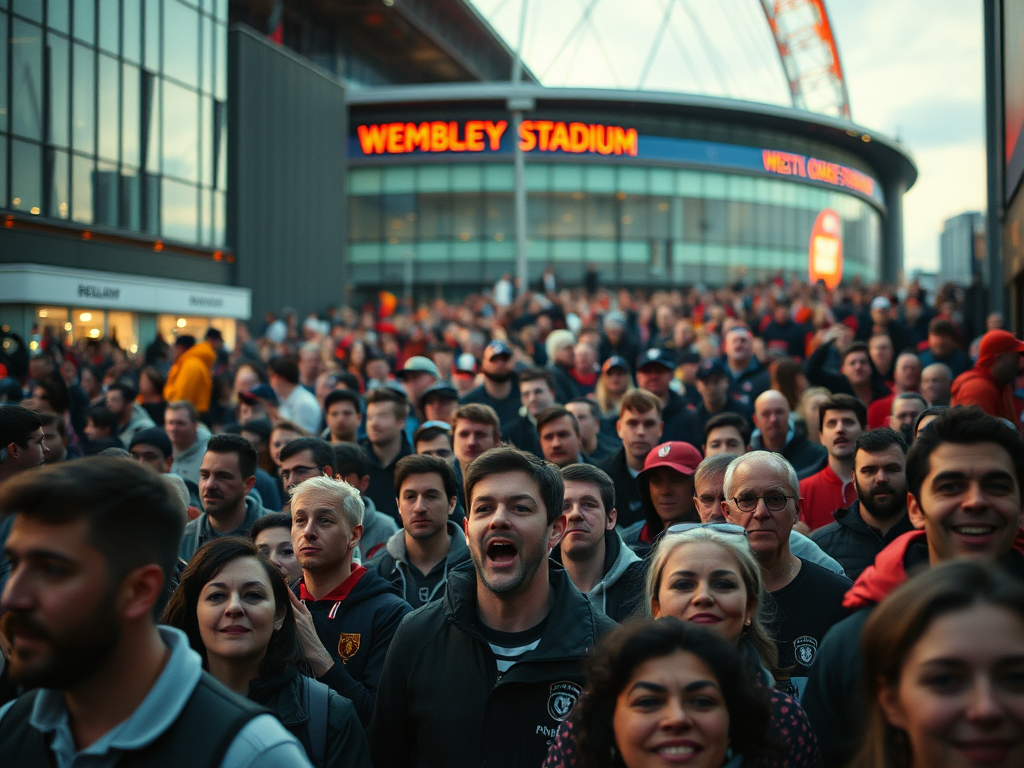
Crowds leave Wembley.
“Well how about that”, one BBC commentator said, as full-time was called on the England-Ukraine quarter final match of the men’s 2020 European Championship, and players hugged on the pitch. “England dominating and giving the nation not only something to cheer with, an outstanding performance and four goals, but also”, he paused, “a largely stress-free evening.”
Stress-free evenings are very much in order for a lot of people after 15 months of pandemic and all the worry that has gone with that. From a psychological perspective, fans’ perceptions of their team’s progress throughout the Euros will resemble many people’s perceptions of daily life during the COVID crisis – a lack of control over events and uncertainty over what will happen next.
Another of the BBC’s commentators talking viewers through the Ukraine match said it had been “like the greatest therapy session England has ever had”. And if so, there’s no doubt it is a mass therapy exercise, especially after the nation was gripped by England’s winning semi-final performance against Denmark.
Football (whether you like it or not) is the world’s favourite sport. In England, it’s considered the national game. An estimated 1.9 million Britons played the game at least twice a month in 2020. And England’s major tournament matches are consistently watched by over 10 million households.
Social ingroup
Research shows that international football tournaments can take us on a rollercoaster of emotions. The more we identify with our team, the more our feelings are connected to their performance. In extreme cases, this emotional ride while watching football has been linked to a higher risk of heart attacks.Displays of allegiance among the fans during the Euro 2020 quarterfinal between England and Ukraine. Marcello Valeri / Alamy Live News
When the England team beat Germany in the last 16, they conquered an arch nemesis. In beating Denmark and getting into the final two, England have reached their first European championship final – their first international tournament final since the 1966 World Cup. For England supporters, this is a big deal.
Things were very different during the Euro 2016 tournament. When the English side lost to Iceland in the round of 16, pundits and fans alike expressed anger and grief. It was “full-on humiliation”. It compounded “20 years of hurt”.
When you socially identify as part of a group (such as fans identifying with a football team) it makes you feel good. It has been found to be positive for your self-esteem.
Conversely, when the status of the group with which you identify is threatened (by, say, an opposing team on a winning streak), there can be a tendency to become protective. You might experience the same emotions that you believe your group is experiencing (as fans do when watching their team during a match) because of this sense of belonging.
Collective emotions
Research has shown that the collective emotions that football teams experience as a whole strongly influence the emotions that distinct individuals in the team – which psychologists term a social ingroup) – experience. A similar transference of emotions from the group to individuals can be seen happening between the players on the pitch and the fans in the stands, as the fans are included in the ingroup.
Thus, when players and TV pundits respond positively and intensely to a team’s performances, the fans follow suit: the collective emotions are clear to see. The strong social identity that fans derive from those emotions has been found to be positively reinforced. A sea of red and white as 20,500 England and Croatian football fans leave Wembley stadium after a group stage game.Eleventh Hour Photography / Alamy Stock Photo
Many fans, therefore will also have found the smoothness – the stress-free nature, as that commentator put it – of the England match against Ukraine, reassuring.
Living vicariously with England’s progress through the Euros might, however, also be taking its toll. The thought of ending up in another losing penalty shootout with Germany was, for some fans, nerve-wracking and emotionally draining.
So too, the run-up to the semi-final against Denmark. When Alan Shearer asked Southgate whether he was able to enjoy this as much as fans are back home, he both smiled and shook his head. “Not really Alan, no, no,” he said. “We’re in another semi-final. That’s three in three years.” And now England is headed to the final against Italy, the pressure is very much on.
Ahead of the match against Germany, individual players including Marcus Rashford spoke up to reassure – or perhaps convince – people that the new-generation Three Lions team had, as one journalist put it, “ended the nation’s penalty jinx”.
The fears don’t stop there though. This weight of expectation for England to end 55 “years of hurt” and win the tournament is now the new collective anxiety.
It is important to recognise that anxiety, and to understand how it might be countered by sharing the moment with like-minded people. Whether the results are good or bad, watching a match with friends and family can help to actively regulate emotions – to control your own emotional state.
Research has found that emotional regulation plays a central role in mental health and wellbeing. So celebrate together if your team wins. And if things don’t go the way you want them to, don’t be alone. Watch with people who care as much as you do.